

Even Technology Lends a Hand: Why Flawed SOPs Are Still Killing Hospitality and Service Mindsets in Vietnam

Updated: Apr 9
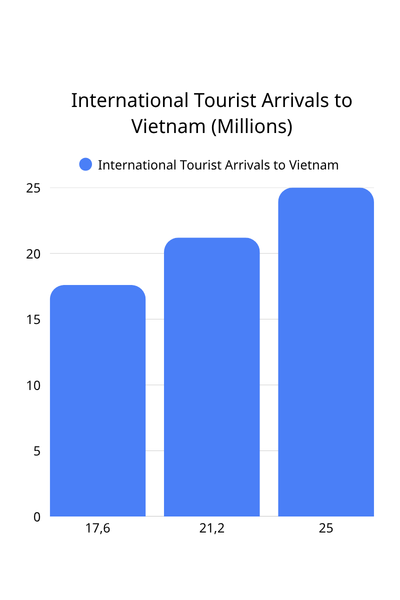
Vietnam’s hospitality industry is riding an unprecedented wave. In 2025, the country shattered records with nearly 21.2 million international visitors—an all-time high, up 20.4% from 2024 and surpassing pre-pandemic levels by 17.8% (Tường Bách, 2026). Early 2026 has kept the momentum strong: 4.68 million foreign arrivals in the first two months alone, a solid 18.1% year-on-year increase (Tường Bách, 2026). The government is targeting 25 million international visitors for the full year (Kim Anh, 2026), while the hospitality market itself is forecast to grow at a robust 12.07% CAGR (Compound Annual Growth Rate) through 2034 (IMARC Group, n.d).
At the same time, technology has flooded in. The Vietnam hotel and hospitality management software market size reached USD 15.47 Million in 2025. The market is projected to reach USD 22.69 Million by 2034, exhibiting a growth rate (CAGR) of 4.35% during 2026-2034 (IMARC Group, n.d). Property Management Systems (PMS), AI-powered chatbots, IoT-enabled smart rooms, contactless check-in, service robots, and data analytics are now commonplace in major cities. Over 60% of hotels in key tourist hubs are expected to adopt smart technologies within the next five years (Karl Wood, 2025). Events like HorecFex 2025 showcased robots, AI concierges, and 4D immersive systems worth billions of VND (Báo Văn Hóa, 2025).
On paper, tech should be a savior—streamlining operations, reducing errors, personalizing experiences, and freeing staff for genuine guest interactions. Yet the service mindset crisis persists. Guests still encounter robotic check-ins, inconsistent service, and a noticeable lack of Vietnamese warmth. The culprit? Flawed Standard Operating Procedures (SOPs)—strict, loose, half-baked, lengthy, confusing, or inconsistent—that have not evolved alongside the technology. Even as tech helps, outdated or poorly adapted SOPs continue to erode the human heart of hospitality, especially amid the same East-West organizational confusion that plagues the industry.
⸻
How Technology Is Helping (But Not Enough)
Modern tools are delivering real gains:

AI chatbots and digital concierges handle 85%+ of routine queries in some properties, enabling multilingual support, faster bookings, and upselling—boosting direct bookings by around 10% in integrated systems (Ludu Fourrage, 2025).
PMS and automation optimize inventory, housekeeping schedules, and revenue management, cutting labor costs and waste while improving operational efficiency.
·Smart rooms and contactless tech enhance guest convenience and safety, aligning with post-pandemic expectations.
Data analytics allow personalized recommendations and dynamic pricing.
These advancements are particularly visible in international chains and upscale Vietnamese resorts. They reduce mundane tasks, theoretically giving frontline staff more time to deliver the relational, empathetic service that defines Eastern hospitality.
Why SOPs Are Still Suffering—and Dragging Everything Down
The problem is that technology is being bolted onto broken processes.
The problem is that technology is being bolted onto broken processes. SOPs were never redesigned to leverage these tools; they remain rigid relics of the past or inconsistently applied hybrids that confuse rather than empower.

Strict, rule-bound SOPs clash with tech’s flexibility. Staff are trained to follow scripts verbatim—even when an AI system flags a guest preference or suggests a compassionate workaround. A chatbot might offer a complimentary upgrade, but the SOP blocks it unless a manager approves. Result? Guests sense the disconnect between slick tech and cold human execution.
Loose or half-way SOPs create chaos in tech-enabled environments. One team uses the PMS properly; another bypasses it with paper notes or WhatsApp. Inconsistent data leads to double-bookings, lost preferences, or frustrated guests who experience “smart hotel” features that don’t actually work reliably.
Lengthy, confusing, or inconsistent SOPs become even more toxic with technology. Thick manuals full of corporate jargon don’t reference new AI workflows or robot protocols. Frontline employees—many still undertrained amid Vietnam’s talent shortage—ignore or misunderstand them, leading to errors that tech was supposed to prevent. Training sessions focus on “click here” rather than “how to use this tool to delight a guest while preserving face and harmony.”
Compounding this is the familiar organizational politics: local managers import Western tech-driven SOPs to impress investors (“We have AI like the big chains!”) while retaining Eastern hierarchical control, favoritism, and “don’t rock the boat” culture. The result is a Frankenstein system—tech promises efficiency and personalization, but SOPs demand compliance and risk-aversion. Staff feel disempowered: robots handle the easy stuff, yet humans are still punished for deviating from outdated rules. High turnover persists (often 30–85% in segments), fueled by unclear career paths, poor communication, and systems that treat people as button-pushers rather than hospitality creators (Michael, 2022; Hotel Business, 2025).
SMEs (Small and Medium-sized Enterprises), which make up over 80% of the sector, face the worst of it (Nguyen Thi Hue & Luu Thi Mai Phuong, 2025). Limited budgets mean superficial tech adoption—off-the-shelf software without integration or proper SOP updates. Managerial resistance to AI is common, rooted in fears of losing the human touch that defines Vietnamese hospitality. The digital divide widens: flashy apps exist, but service quality lags because the underlying procedures were never fixed.
The Data Confirms the Gap
Despite tech investments, service complaints haven’t vanished. Studies on digital transformation in Vietnam’s tourism and hospitality highlight persistent challenges: fragmented systems, human resource gaps, and superficial adoption that fail to translate into better guest experiences (Appota, 2025; Hồng Lụa, 2025). Guest satisfaction surveys and online reviews still flag staff-related issues—robotic interactions, inconsistency, and lack of empathy—even in properties touting “smart” features. AI awareness among employees can even increase turnover intention if perceived as a threat rather than a partner, unless supported by empowering SOPs and training.
In short, technology amplifies whatever SOPs exist. When those SOPs are flawed, tech doesn’t save the service mindset—it exposes and accelerates its decline.
Technology amplifies whatever SOPs exist. When those SOPs are flawed, tech doesn’t save the service mindset—it exposes and accelerates its decline.
The Path Forward: SOPs Must Evolve with the Tech

Vietnam’s hospitality boom and tech surge present a golden opportunity. But tools alone won’t preserve the warmth, empathy, and relational magic that make Vietnam special. Leaders must treat SOPs as living frameworks—not static rulebooks—that blend global tech efficiency with Eastern strengths: flexibility within clear boundaries, empowerment for frontline initiative, and a focus on guest delight over blind compliance.
But tools alone won’t preserve the warmth, empathy, and relational magic that make Vietnam special.
Only then can technology truly help rather than highlight the cracks. Until SOPs catch up, even the smartest robots and sleekest apps will leave guests feeling the same quiet disappointment: great systems, hollow service, and a service mindset quietly dying one interaction at a time.


Weatwork.co is Vietnam's pioneering platform for aligning goals and teams.
Our products are uniquely tailored to fit Vietnamese and Asian work cultures, transforming individual and team ideas into impactful, organization-wide actions through lean thinking, design thinking, infographics, animated videos, and comics.
Our mission extends to redefining organizational and people development models in Vietnam and globally, aiming to prepare purpose-driven leaders and foster people-centric organizations in an ever-evolving business landscape.
Contact us at support@weatwork.co & +84888673222


Comments