

The 5 Biggest Mistakes Organizations Make in AI Adoption: Why Piecemeal Departmental Efforts Fail – And Why Integrated AI Agents Under Enterprise Governance Deliver Real Value

In 2026, most organizations are deep into AI experimentation. Yet despite massive investments—global generative AI spending exceeded $200 billion in 2025—results remain disappointing. McKinsey reports that 88% of organizations are experimenting with AI, but 81% see no meaningful bottom-line gains. MIT NANDA State of AI in Business study is even starker: 95% of generative AI pilots deliver zero measurable P&L impact (Challapally, A., Pease, C., Raskar, R., & Chari, P., 2025)
88% of organizations are experimenting with AI, but 81% see no meaningful bottom-line gains
The root cause isn’t the technology. It’s piecemeal, department-by-department adoption—each team picking its own tools, building isolated pilots, and creating “AI sprawl.” Most businesses still deploy AI in isolated ways across individual departments, resulting in scattered AI initiatives, fragmented data, and limited integrated value. In contrast, leading organizations are shifting toward an integrated AI agent model, in which functions operate across departments under a unified governance framework for data, security, and risk, as highlighted in Deloitte’s State of AI in the Enterprise 2026 report (Deloitte AI Institute, 2026).
The root cause isn’t the technology. It’s piecemeal, department-by-department adoption—each team picking its own tools, building isolated pilots, and creating “AI sprawl.
Below, WEATWORK identifies and analyzes the five biggest mistakes that cause department-by-department AI approaches to fail, thereby clarifying why an integrated AI Agent is the key solution to this challenge.
Mistake 1: Starting with Technology Instead of Enterprise-Wide Business Problems

The most common mistake today is that departments are often drawn to the flashy demos of new tools such as ChatGPT Enterprise or Copilot, while losing sight of their strategic objectives.
When each department independently selects its own tool to vaguely “experiment with automation,” the organization unintentionally creates a fragmented ecosystem. Marketing may use one platform while Finance relies on another, resulting in broken data flows and a complete lack of cross-functional coordination.
McKinsey’s research shows that the lack of a clear strategy is the leading barrier for 43% of organizations, causing pilot projects to fall into the “pilot trap” and preventing them from ever scaling successfully.
To address this, every AI initiative must begin with an enterprise-level business problem and be executed through integrated AI Agents—systems designed from the outset to manage cross-functional processes under the governance of a central AI council.
Every AI initiative must originate from the organization’s core business problem and be addressed through AI solutions that involve cross-functional collaboration across departments.
Mistake 2: Underestimating Data Quality and Readiness in Your Department

Another serious mistake is underestimating data quality and data fragmentation across the organization. Many departments assume that their internal data is sufficient, but in reality, data is often scattered, duplicated, or lacking standardization. This prevents AI from operating effectively, especially when deployed at scale.
According to Gartner and Deloitte’s 2026 reports, data fragmentation is a major factor behind why 74% of enterprises face difficulties in proving AI’s tangible business value (Boston Consulting Group, 2024). An autonomous AI Agent requires a unified data foundation to reduce the risk of hallucinations and prevent potential breaches of security policies.
Instead of allowing each department to manage its own data independently, leading organizations are building centralized data catalogs and secure access layers, enabling AI Agents to operate on a shared foundation with consistent control rules across departmental boundaries.
Instead of allowing each department to manage its own data separately, organizations need to centralize data and establish secure access layers, enabling AI Agents to operate on a shared platform with strict organization-wide control.
Mistake 3: Ignoring the Enterprise Skills Gap and Treating Training as Optional

The third mistake is underestimating AI training and the enterprise-wide skills gap. Many organizations focus only on hiring AI specialists while neglecting to upskill their existing workforce. As a result, employees are unable to interact effectively with AI, lack the ability to evaluate or control its outputs, and ultimately leave AI isolated rather than integrated into business processes.
According to Deloitte, the lack of skills is the biggest barrier to integrating AI into work, while McKinsey & Company reports that 86% of leaders feel their organizations are not yet ready for the daily adoption of AI (Krivkovich, A., Klingler, D., Maor, D., Guggenberger, P., & Anzenhofer, M., 2026)
The solution is to implement role-based training and establish AI centers of excellence to spread capabilities across the organization.
The solution is to implement role-based training and establish AI centers of excellence to spread capabilities across the organization.
Mistake 4: Neglecting Change Management and Organizational “AI Angst”
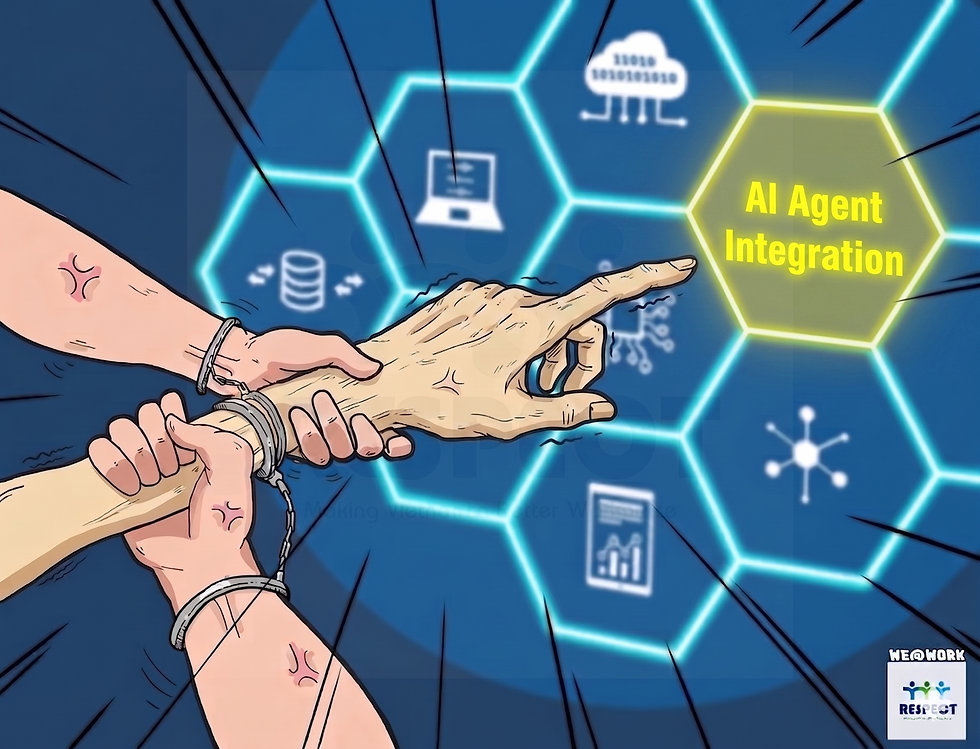
AI is not merely a technical upgrade; it is a cultural transformation. Many businesses roll out AI through dry announcement emails while overlooking the very real “AI anxiety” that exists within their own workforce.
AI is not just a technical upgrade; it is a cultural transformation.
According to research published by Harvard Business Review, around 80% of employees experience fears of being replaced or losing autonomy, which leads to hidden resistance or merely performative participation. Fragmented adoption further worsens this situation, as employees see tools being introduced in a chaotic and uncoordinated manner (Lovich, D., Meier, S., & Taylor, C., 2025).
The right approach is to position AI Agents as “digital teammates” that handle repetitive tasks, allowing people to focus on judgment and strategy. Successful organizations are those that treat AI as a “dual transformation”—one that not only changes technical processes but also redefines the relationship between humans and machines.
AI Agents should be positioned as digital teammates, freeing people from repetitive work so they can focus on judgment and strategy.
Mistake 5: Scaling Too Quickly Without Enterprise Governance Rules
The final mistake is scaling AI without an appropriate governance system. Many organizations expand AI widely after a few early successes without establishing standards, control processes, or oversight mechanisms. This creates risks related to security, compliance, and ethics, while also weakening integration across the organization.

Gartner forecasts that more than 40% of agentic AI projects will be cancelled by 2027 due to uncontrolled costs or ethical and security risks. When Agents operate under inconsistent rules, organizations face the danger of data leakage and policy chaos (Gartner, 2025).
Establishing a centralized AI governance council to define rules for access control, audit logging, and ethical guidelines is essential before scaling. Integrated AI Agents must be treated as strategic company infrastructure, with clear KPIs and accountability at the highest leadership level.
Integrated AI Agents must be treated as strategic company infrastructure, with clear KPIs and accountability at the highest level of leadership.
Conclusion: From Fragmented Tools to Governed, Integrated AI Agents
Business leaders must move beyond the mindset of “AI in my department” toward a broader vision of “AI for the entire organization.” The winners in 2026 will not be those with the most pilot projects, but those that treat AI as an enterprise operating system—where integrated AI Agents collaborate across functions on a shared data foundation under strong governance.
Start by breaking down departmental silos and piloting use cases that span at least two functions in order to see the real value that AI Agents can deliver!

Weatwork.co is Vietnam's pioneering platform for aligning goals and teams.
Our products are uniquely tailored to fit Vietnamese and Asian work cultures, transforming individual and team ideas into impactful, organization-wide actions through lean thinking, design thinking, infographics, animated videos, and comics.
Our mission extends to redefining organizational and people development models in Vietnam and globally, aiming to prepare purpose-driven leaders and foster people-centric organizations in an ever-evolving business landscape.
Contact us at support@weatwork.co & +84888673222


Comments